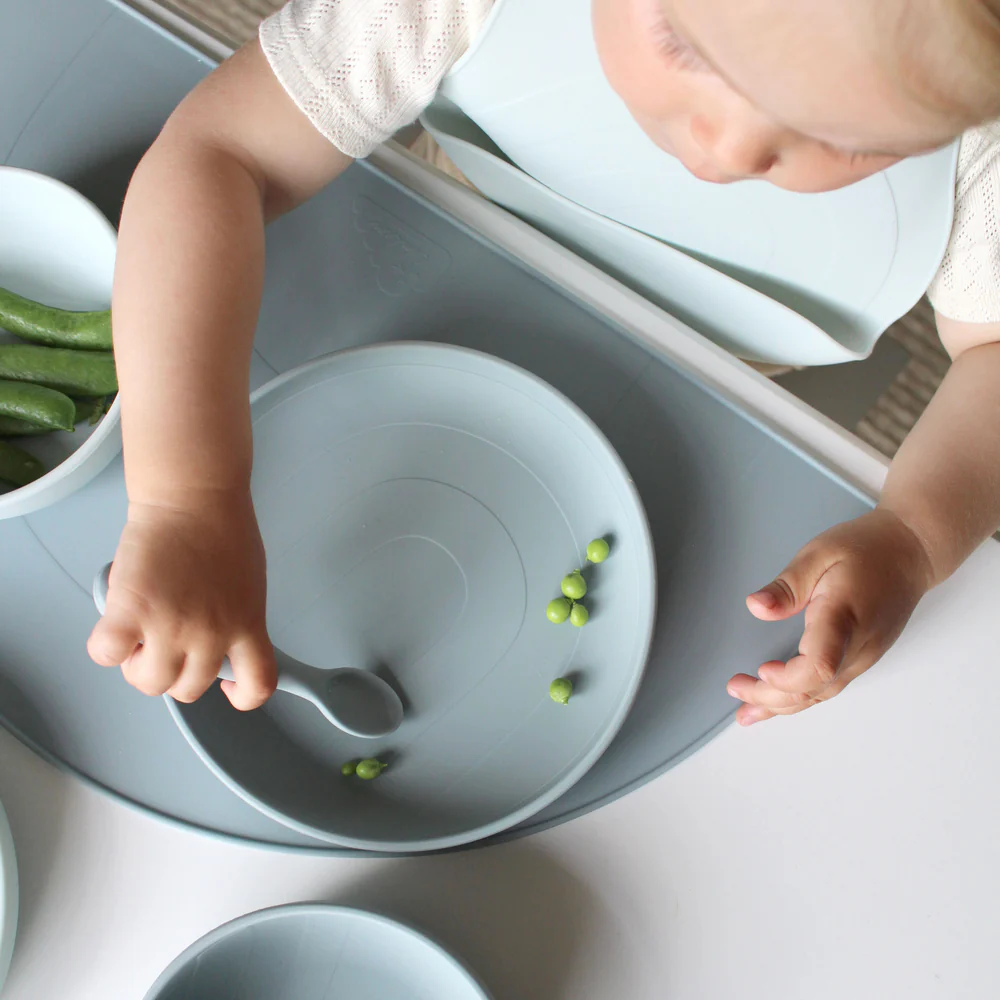
Learning to eat independently is an important part of a baby’s development, but it rarely happens neatly or overnight. Before children can confidently use bowls, plates and cutlery, they need plenty of opportunities to explore food, practise movements and understand what happens when they try to feed themselves.
Parents can encourage independent eating safely by taking a gradual approach, choosing feeding products suited to their child’s stage and continuing to provide appropriate supervision and assistance. The aim is not to rush babies towards completely independent mealtimes. Instead, parents can give them opportunities to participate and develop their skills at a comfortable pace.
It is also important to remember that every child develops differently. One baby may quickly become determined to hold their own spoon, while another may be perfectly happy receiving more help for longer.
When do babies start showing an interest in feeding themselves?
Interest in independent eating often develops naturally as babies begin exploring food and watching other people eat.
Parents might notice their child:
- Reaching towards food
- Trying to pick up suitable pieces of food
- Grabbing a spoon
- Watching parents use cutlery
- Attempting to move food towards their mouth
- Showing an interest in bowls and plates
These behaviours are part of learning.
A baby does not need to understand exactly how cutlery works before being allowed to explore appropriate feeding products. Holding, turning and examining these items can form part of the learning process.
Follow development rather than a deadline
There is no need to treat independent eating as something a child must achieve by one particular date.
Development varies considerably between babies.
Parents can respond to their child’s growing abilities rather than comparing their progress with other children.
How can parents introduce self-feeding gradually?
Independent eating does not need to be an all-or-nothing decision.
Parents can continue helping their child while simultaneously creating opportunities for self-feeding.
For example, a parent might use one spoon to help with feeding while allowing their baby to hold another suitable spoon.
Over time, the child can become increasingly involved.
Start with manageable opportunities
Early attempts at self-feeding may involve relatively simple actions.
A baby might begin by:
- Picking up appropriate food
- Holding a spoon
- Exploring a bowl
- Attempting to scoop food
- Moving food towards their mouth
These small actions help develop the coordination required for more independent eating later.
Expect experimentation
Babies may not initially understand that a spoon is intended for transferring food from a bowl to their mouth.
They may bang it on the table.
They may turn it upside down.
They may drop it.
They may simply hold it while eating food with their other hand.
This experimentation is normal. Babies learn through repetition and experience.
How can bowls, plates and cutlery support independent eating?
Suitable feeding accessories can help create an environment in which babies can practise their developing skills.
Bowls, plates and cutlery each have a slightly different role.
Bowls
Bowls can help contain food and provide a defined area from which children can practise picking up or scooping food.
As coordination develops, babies gradually learn how to interact with the bowl more deliberately.
Plates
Plates can make different foods easier for children to see and explore.
They can also help babies become familiar with the way family meals are served.
As children grow, having their own plate can help them feel more involved in family mealtimes.
Cutlery
Baby cutlery gives children an opportunity to practise more precise movements.
Using a spoon or other suitable utensil involves several developing abilities working together, including:
- Gripping
- Hand-eye coordination
- Scooping
- Lifting
- Moving towards the mouth
These skills take time to develop, so parents should not expect perfect cutlery use immediately.
Why is supervision important during independent eating?
Babies and young children should be appropriately supervised during meals.
Independent eating means allowing children to develop skills themselves. It does not mean leaving them to manage mealtimes without an adult present.
Parents and caregivers can remain involved while allowing the child increasing opportunities to participate.
Stay close and attentive
Mealtimes are an opportunity for shared interaction as well as eating.
Parents can sit with their child, observe how they are managing and provide help when required.
This can also make the experience more enjoyable.
Rather than viewing self-feeding as a task the baby needs to complete alone, families can treat it as part of eating together.
Follow appropriate feeding guidance
Parents should follow appropriate professional guidance regarding weaning, food preparation and suitable foods for their baby’s age and developmental stage.
If there are questions about a child’s individual feeding needs, development, allergies or ability to manage particular foods, parents should seek appropriate professional advice rather than relying solely on general guidance.
How can parents create a suitable environment for learning to eat?
The environment can make a significant difference to how manageable independent eating feels.
Babies need an appropriate place to eat where parents can supervise them and where feeding products are easy to use.
Prepare before the meal starts
Parents may find it useful to have everything ready beforehand, including:
- Bowl or plate
- Suitable cutlery
- Bib
- Cleaning cloth
- Any other feeding essentials
This reduces the need to repeatedly leave the eating area once the meal has started.
Keep the environment relatively calm
Babies already have plenty to think about when learning to eat.
Too many distractions can make it harder for them to concentrate on the meal.
A calmer mealtime can give children an opportunity to explore food and practise movements without competing for attention with lots of other activities.
Is messy eating a problem?
For many parents, this is one of the biggest adjustments involved in encouraging independence.
Self-feeding is messy.
Food may end up:
- On the table
- On clothing
- On the floor
- On the feeding chair
- In the baby’s hair
While practical feeding products can help contain some of this mess, they are unlikely to eliminate it.
Mess can be part of exploration
Babies learn about food through more than taste.
They also explore:
- Texture
- Shape
- Consistency
- Temperature
- Movement
Touching and handling suitable foods can therefore form part of the learning experience.
Parents can make the process easier by preparing for mess rather than expecting to prevent it completely.
Bibs can help
A practical bib can protect clothing and make cleaning up afterwards more manageable.
Having spare bibs available can also be helpful when several meals or snacks take place throughout the day.
How can family mealtimes encourage independence?
Babies learn a great deal by watching other people.
Eating together gives them opportunities to observe how parents and other family members interact with food, bowls, plates and cutlery.
They may begin trying to imitate what they see.
Allow babies to participate
Where appropriate for the child’s stage, having their own feeding products can help babies feel included in the meal.
This turns eating into a shared family activity rather than something that happens separately to them.
Talk during mealtimes
Parents can also use meals as opportunities for interaction.
Simple conversation about food can introduce words and concepts naturally.
For example, parents might talk about:
- What the child is eating
- Different colours
- Textures
- Shapes
- What other family members are eating
The primary purpose remains enjoying the meal, rather than turning it into a formal lesson.
What should parents expect as babies become more independent?
Progress is rarely linear.
A child may enthusiastically use a spoon one day and show no interest in it the next.
They may master one movement and struggle with another.
This is normal.
Independence develops gradually
Early self-feeding often involves considerable assistance.
As coordination improves, parents may notice their child becoming more capable of:
- Picking up food
- Holding feeding products
- Scooping
- Controlling movements
- Drinking
- Participating in meals
Over time, the balance shifts naturally towards greater independence.
Avoid making comparisons
It can be tempting to compare a baby’s progress with friends, siblings or other children of a similar age.
However, children develop at different rates.
Parents can focus instead on providing appropriate opportunities to practise.
How should parents choose feeding products?
Practical feeding products should suit both the child’s developmental stage and everyday family routines.
Parents might consider:
- Size
- Ease of handling
- Practicality
- Ease of cleaning
- Durability
- Suitability for regular use
Products that are straightforward to use and clean often become more valuable than complicated accessories.
Think about the child’s developing skills
A young baby’s needs will differ from those of a toddler who already has experience with self-feeding.
Feeding products can change as abilities develop.
The aim is to support progress without making the process unnecessarily difficult.
How can parents make independent eating less stressful?
Parents can sometimes feel pressure to make rapid progress with feeding.
A more relaxed approach may make the experience more enjoyable for everyone.
It can help to:
- Introduce opportunities gradually.
- Accept that some mess is inevitable.
- Continue helping when necessary.
- Let the child practise suitable skills.
- Keep mealtimes positive rather than focusing on perfect technique.
Independent eating is a learning process.
Like crawling, walking or talking, it develops through repeated opportunities rather than one perfect attempt.
Frequently Asked Questions
When should babies start feeding themselves?
There is no single point at which every baby should suddenly become an independent eater. Babies often begin participating more as they progress through weaning and develop the coordination needed to handle food and feeding products.
Should I let my baby hold a spoon while I feed them?
Allowing a baby to explore an age-appropriate spoon can give them an opportunity to practise holding and moving it while a parent continues helping with the meal.
Why does my baby keep dropping their cutlery?
Dropping objects is common during early development. Babies are learning how objects move and what happens when they release them. Patiently providing opportunities to practise can help skills develop over time.
Are bowls and plates useful when babies first start eating?
They can be. Bowls and plates help introduce babies to feeding products they will increasingly use as they become more independent.
How can I make self-feeding less messy?
Bibs and practical bowls or plates can help manage some mess, while preparing the eating area beforehand can make cleaning easier. However, some mess is a normal part of babies exploring food and learning to feed themselves.
Supporting confident, independent mealtimes
Encouraging independent eating is not about asking babies to manage meals entirely by themselves. It is about gradually giving them opportunities to participate while parents continue providing the supervision and support they need.
Suitable bowls, plates, cutlery and bibs can make this process easier by giving children practical tools with which to practise. Shared family meals can provide examples to copy, while a patient approach allows skills to develop naturally.
There will almost certainly be spills, dropped spoons and meals where more food reaches the floor than expected. These moments are part of the process.
By focusing on gradual progress rather than perfect table manners, parents can help children build confidence and become increasingly involved in enjoyable family mealtimes.
Nino’s Dreams offers feeding and weaning accessories including bibs, bowls, plates and cutlery, thoughtfully selected with growing families in mind.
Phone: 0208 0497 882
Email: info@ninosdreams.co.uk
Find out more: Nino’s Dreams