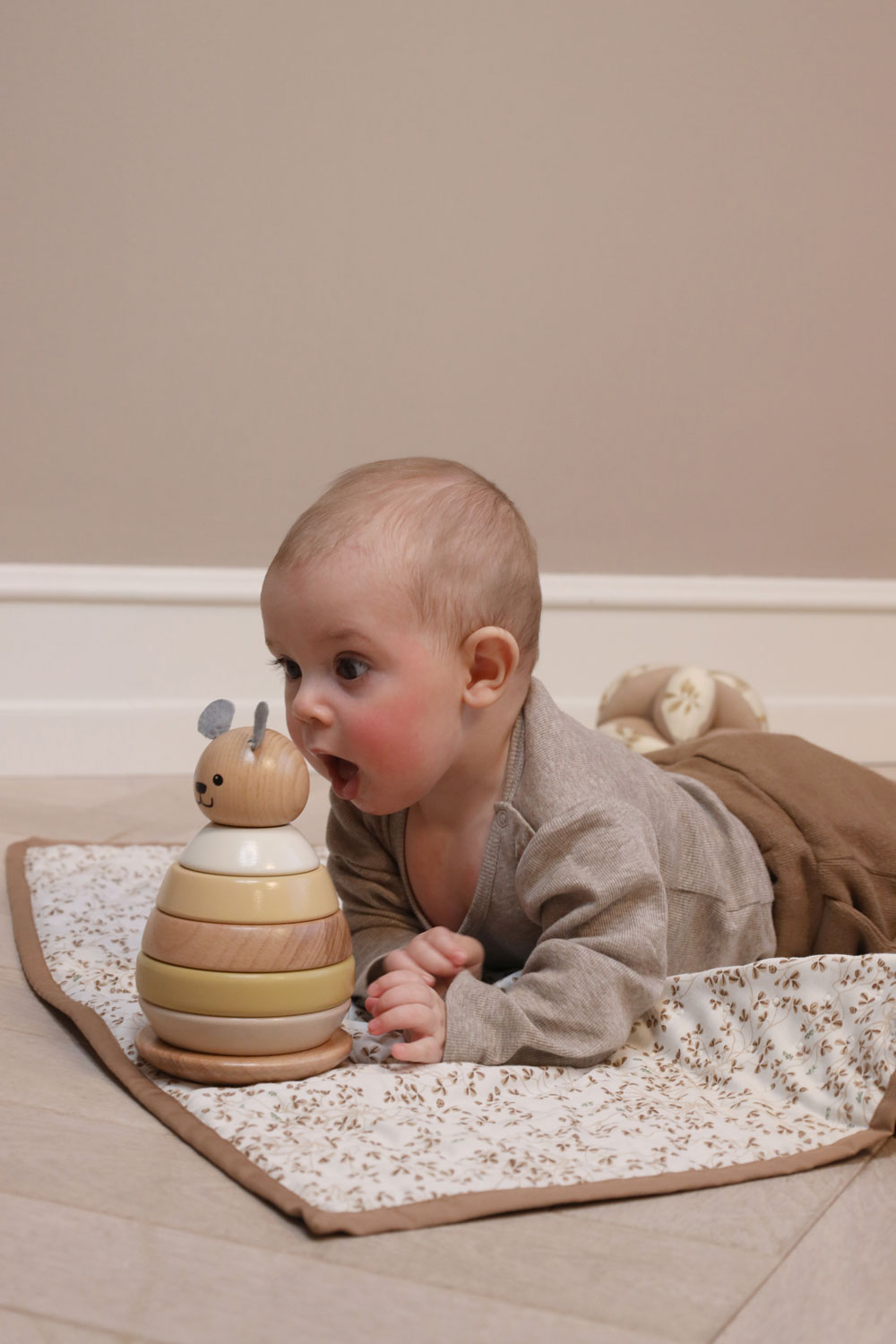
Walk into almost any baby shop and it would be easy to assume that babies need an enormous collection of toys. There are products designed for different ages, abilities, senses and stages of development, and parents can understandably wonder whether they are providing enough opportunities for their child to play and explore.
So, how many toys does a baby really need? There is no particular number that every baby should have. In practice, a smaller, varied selection of suitable toys can provide plenty of opportunities for play, interaction and exploration. Babies also learn from their parents, everyday objects, movement and the environment around them, so toys are only one part of their early experiences.
Instead of concentrating on quantity, it is generally more useful to think about variety, suitability and whether individual toys genuinely interest your child.
Do babies need lots of toys for healthy development?
Babies are naturally curious about the world around them. A toy can give them something interesting to look at, touch, grasp or interact with, but it does not need to have lots of complicated features to provide an engaging experience.
Young babies can find seemingly simple things fascinating.
Movement, texture, colour, shapes and sounds can all capture their attention. As they develop greater control over their bodies, they may begin reaching towards interesting objects, grasping suitable toys and exploring what happens when they move them.
A smaller selection of appropriate toys can provide opportunities for these experiences without parents feeling that they need to continually buy something new.
Everyday interaction matters too
Parents should not feel that toys have to provide all of their baby’s stimulation or entertainment.
Interaction with parents and caregivers can include:
- Talking
- Singing
- Making facial expressions
- Playing simple games
- Looking at things together
- Encouraging suitable movement and exploration
A baby may be just as interested in interacting with a parent as they are in a new toy.
Toys can complement these experiences rather than replace them.
What types of toys are useful at different stages?
Babies change considerably during their first year, so the toys that interest them can change too.
This is one reason why buying a large collection before a baby arrives may not be necessary. Parents cannot always predict which products their individual child will enjoy.
Early months
During the earliest months, babies are still developing their awareness of their surroundings.
They may show interest in:
- Faces
- Contrasting colours
- Movement
- Gentle sounds
- Different textures
Suitable toys can provide additional things to observe and explore.
Parents can also interact with toys alongside their baby, rather than expecting the baby to play independently.
As reaching and grasping develop
Once babies become more interested in reaching for objects, suitable toys can provide opportunities to practise these developing movements.
A baby may repeatedly:
- Reach for a toy
- Hold it
- Turn it around
- Move it between their hands
- Drop it
- Pick it up again
To an adult, this may appear very repetitive. For a baby, however, the same toy can provide many different experiences as their abilities develop.
As babies become more mobile
When babies begin moving around more independently, the way they play can change again.
A playmat can provide a defined area for appropriate supervised floor play, with a small selection of suitable toys introduced according to the child’s stage.
A toy that was previously something to look at may later become something the baby actively reaches towards or moves to investigate.
The child’s development can change the way an existing toy is used without the toy itself needing to change.
Is having too many toys a problem?
There is nothing inherently wrong with a child owning plenty of toys, particularly when gifts accumulate from birthdays, Christmas and visits from family and friends.
However, having a large number available simultaneously is not necessarily more useful than having a smaller selection.
Parents may find that too many toys make it harder to:
- Keep play areas organised
- See which toys the baby actually enjoys
- Store products neatly
- Keep track of age suitability
- Maintain a calm play environment
A large collection can also mean individual toys receive relatively little use.
More toys do not automatically mean more variety
Ten toys offering very similar experiences may provide less variety than a smaller selection chosen for different types of play.
Rather than counting toys, parents can consider what opportunities their collection provides.
For example, do the available toys offer different:
- Textures?
- Shapes?
- Ways to interact?
- Visual experiences?
- Opportunities for movement?
Thinking this way can make choosing toys more straightforward.
Can rotating toys keep babies interested?
Toy rotation can be a useful way to manage a growing collection without having everything available at once.
The basic idea is simple.
Some toys remain available for play while others are stored away. After a period of time, the selection is changed.
A toy that has been out of sight for a while may attract renewed attention when it returns.
Rotation does not need to be complicated
Parents do not need to create a formal schedule or rotate toys on a particular day.
Instead, they can simply observe what is happening.
If several toys are being ignored, those products could be put away temporarily while something different is introduced.
This also gives parents an opportunity to review the collection and check whether each toy is still appropriate for the child’s current stage.
Baskets can make rotation easier
Storage baskets can provide a straightforward way to keep toys organised.
Rather than filling the entire nursery or living room with toys, parents can keep a manageable selection accessible and store the remainder separately.
As children grow, the same baskets can continue being useful for toys, games or other belongings.
How can parents make a smaller toy collection more interesting?
A small collection does not have to mean repetitive play.
The way parents introduce and use toys can make a significant difference.
Play together
Parent interaction can turn a simple toy into a shared activity.
Depending on the child’s stage, parents might:
- Move the toy for their baby to follow
- Talk about its features
- Demonstrate what it does
- Encourage reaching
- Respond when the baby interacts with it
The same toy can therefore support many different interactions.
Change the play environment
A toy does not always have to be used in exactly the same location.
A suitable favourite might be used during supervised play on a playmat, taken on an appropriate family trip or introduced during quiet play elsewhere in the home.
Changing the context can make familiar products feel different.
Follow the baby’s interests
Parents sometimes buy a toy expecting it to become an instant favourite, only for their baby to show little interest.
That is normal.
Babies have individual preferences, and these can change rapidly.
Rather than continually adding new toys, parents can observe what kinds of experiences their child seems to enjoy and use that information when making future choices.
What should parents consider when choosing new baby toys?
When parents do decide to add to the toy collection, suitability should come before novelty.
A toy should be appropriate for its intended user and used according to the instructions supplied with the individual product.
Parents can also consider several practical factors.
Does it offer something different?
If the toy collection already contains several very similar products, another may not add much variety.
A different type of toy could create new opportunities for exploration.
Is it appropriate for the baby’s current stage?
Buying far ahead can result in toys being stored for months before they become relevant.
Choosing products according to the stage the baby is currently in or approaching can make purchases more useful.
Is it practical for your home?
Space matters.
A toy may be appealing but still be impractical if there is nowhere sensible to keep or use it.
This is particularly relevant for families living in smaller homes.
Is it likely to receive regular use?
Parents cannot predict this perfectly, but considering their child’s existing interests can help.
Buying thoughtfully rather than frequently can create a collection that feels more purposeful.
Do babies get bored with the same toys?
Babies can lose interest in individual toys, but their relationship with a toy can also change as new skills develop.
A baby who once simply watched a toy may later learn to reach for it.
Later still, they might grasp, move or manipulate it in a completely different way.
This means parents do not necessarily need to replace toys whenever interest temporarily declines.
Putting a toy away and reintroducing it later can sometimes be enough.
Development can make old toys feel new
As coordination, movement and curiosity develop, babies discover new ways of interacting with familiar products.
The toy has not changed, but the child has.
This is another reason a well-chosen smaller collection can potentially remain interesting for longer than parents expect.
Are expensive toys better for babies?
Price is not a reliable measure of how much a baby will enjoy a toy.
Parents will quickly discover that babies do not understand what something cost.
A more expensive product may be worthwhile if its quality, design or longevity suits the family’s needs, but cost alone does not guarantee that it will become a favourite.
When comparing toys, it can be more useful to consider:
- Suitability
- Quality
- Practicality
- Durability
- The type of play it offers
- Whether it complements existing toys
This keeps the focus on the child’s experience rather than the price tag.
What about toys received as gifts?
Toys are popular presents for babies, so collections can grow without parents buying very much themselves.
There is no need to have every gift available immediately.
Parents can store suitable toys for later and introduce them gradually.
If a toy is intended for an older stage, it can remain stored until it becomes appropriate, with parents following the individual product guidance.
This approach can help spread new experiences across a longer period instead of introducing everything at once.
How can parents keep the toy collection manageable?
A simple system can prevent toys from taking over the home.
Parents can periodically review what they have and separate toys according to whether they are:
- Currently being used
- Suitable for rotation
- Intended for a later stage
- No longer appropriate
This can also make it easier to see whether there are genuine gaps before buying anything else.
If the current selection already provides plenty of varied play opportunities, there may be no need for another purchase.
Toys are only one part of how babies explore
It is easy to think of “play” and “toys” as meaning the same thing, but babies encounter opportunities to learn and explore throughout ordinary family life.
They see new environments.
They hear people speaking.
They experience different sounds.
They interact with parents and other family members.
They practise moving their bodies.
Suitable toys add another dimension to these experiences, but they do not have to provide constant entertainment.
This can take some pressure away from parents who worry that they are not continually providing new activities.
A familiar toy and an engaged parent can create plenty of opportunity for enjoyable interaction.
Frequently Asked Questions
Is there an ideal number of toys for a baby?
No. There is no fixed number of toys that every baby needs. A smaller selection offering varied, age-appropriate opportunities for play and exploration can be more useful than focusing on quantity.
Should all of my baby’s toys be available at once?
They do not need to be. Some parents find toy rotation useful because it keeps play areas manageable and allows familiar toys to be reintroduced after a period away.
Do newborn babies need toys?
Newborns are already experiencing a huge amount through faces, voices, sounds, movement and their surroundings. Suitable toys can gradually be introduced to provide additional opportunities for observation and interaction.
How often should I buy new toys for my baby?
There is no need to buy toys according to a fixed schedule. Parents can consider new products when their child’s abilities and interests change or when a different type of play experience would add useful variety.
What should I look for when buying baby toys?
Look for products suitable for the child’s age and intended use, then consider quality, practicality, durability and what type of play or exploration the toy offers. Always follow the instructions supplied with individual products.
Focus on the quality of play, not the quantity of toys
There is no magic number of toys that guarantees a baby will be entertained, engaged or developing exactly as expected. Babies are individuals, and their interests change as quickly as their abilities.
Instead of trying to build the biggest possible toy collection, parents can focus on providing a manageable variety of suitable options. A few thoughtfully chosen toys can support different kinds of exploration, while rotation can help familiar products remain interesting for longer.
Just as importantly, toys do not need to do all the work. Talking, singing, playing and exploring together provide valuable opportunities for interaction throughout ordinary family life.
As babies grow, parents can watch how they play and introduce different products when their interests and abilities change. This creates a toy collection that develops alongside the child rather than one filled in advance with products they may never use.
Nino’s Dreams offers games and toys as part of its Toys & Gifts range, with products selected around quality, thoughtful design and practical value for growing families.
Phone: 0208 0497 882
Email: info@ninosdreams.co.uk
Find out more: Nino’s Dreams